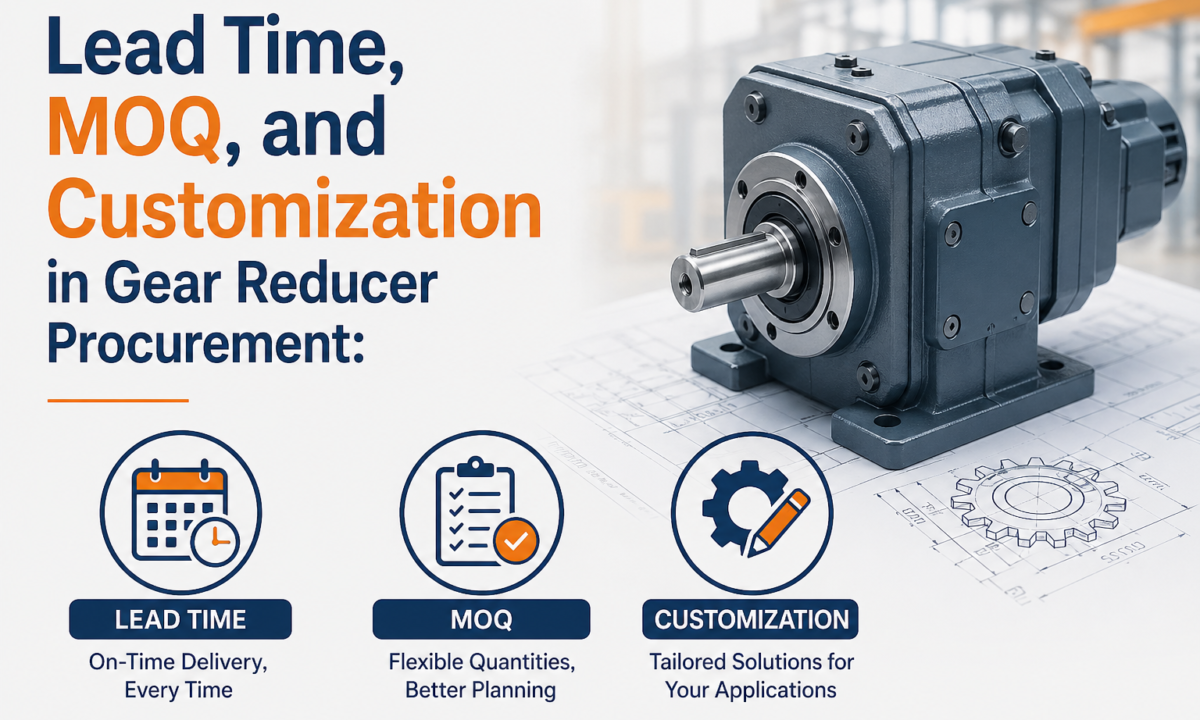
Lead Time, MOQ, and Customization in Gear Reducer Procurement: What You Should Actually Care About.
Lead Time: The Thing That Can Delay Everything
Let’s start with the most annoying thing: Lead time.
You finish everything, place the order, and then the line comes:
“Delivery will take four to six weeks.”
And all of a sudden, your whole timeline changes.
Lead time is just the amount of time it takes to get the gear reducer after you order it. But most people don’t know that this isn’t set in stone.
What actually affects lead time?
- No matter if you’re getting a standard model or a custom one
- If the supplier already has some in stock
- The amount of work they have to do right now
- Availability of raw materials
- Shipping, especially if it’s coming from another country
The real issue
The worst part about lead time isn’t the wait; it’s not knowing what’s going to happen.
Even a week’s delay can change plans for installation, staffing, and sometimes even commitments to clients.
What works better
Don’t just ask, “How long will it take?” Instead, ask:
- What is your realistic delivery range, not just the best case?
- Do you have similar models in stock?
- Is it possible to reserve or book anything ahead of time?
- If you plan ahead, you can avoid a lot of stress later on.
MOQ: Why You’re Asked to Buy More Than You Need?
Now comes the part that most buyers hate: the minimum order quantity (MOQ). You might need 2 or 3 units. The supplier, on the other hand, says that the minimum order is 10.
Does this sound familiar?
Why does MOQ exist?
It really makes sense from the supplier’s point of view:
- They want to keep production running smoothly.
- They cost more when they make small batches.
- Managing bulk orders is easier
But from your side…
- You end up locking extra money in inventory
- Storage becomes an issue
- And sometimes those extra units just sit unused
What you can do about it
This is where a bit of negotiation and strategy helps:
- Ask for a trial order quantity (many suppliers agree)
- Check if they have distributors who sell in smaller numbers
- Go for standard models, which usually don’t have strict MOQ
- If you know future demand is coming, plan bulk smartly
MOQ isn’t something you can always avoid, but you can definitely manage it better.
Customization: Helpful, But Not Always Necessary
Customization sounds great, and sometimes it is.
You get exactly what you need, made for your machine, the way you load it, and how you set it up.
But here’s the thing: not every situation needs it.
When does it make sense to customize?
- When standard gear reducers don’t work with your setup
- When the requirements for performance are very clear
- When the cost up front is less important than long-term efficiency
What people often overlook?
Customization almost always leads to:
- Longer wait times
- More expensive
- And sometimes the MOQ is even higher.
It can fix one problem, but it can also make two more.
A smarter approach
Before you get something customized, ask yourself:
- Can a regular product do 80 to 90 percent of the work?
- Is the extra time and money worth the performance boost?
A standard product that has been changed a little bit often works just fine.
How These Three Are Connected (And Why That Matters)?
This is where things start to get interesting.
Lead time, minimum order quantity (MOQ), and customization are all linked and affect each other.
- The longer the lead time, the more you can customize.
- In many cases, the more personalized the product is, the higher the MOQ.
- If you want your order faster, you won’t have as many customization options.
So there is always a trade-off.
You can’t have:
✔ Product made just for you
✔ Delivered right away
✔ In very small amounts
At least not without paying extra.
What Actually Works in Real Procurement?
After all the theory, here’s what tends to work in real situations:
1. Plan earlier than you think you need to
Even a small buffer helps when delays happen (and they usually do).
2. Don’t over-customize
Only go for it when it genuinely adds value.
3. Build supplier relationships
Suppliers are more flexible with MOQ and timelines when they know you’re a serious, long-term buyer.
4. Always have a backup option
Relying on just one supplier is risky, especially for critical components.
5. Ask better questions
Instead of just price, focus on:
- Delivery reliability
- Flexibility
- Support after purchase
After all the theory, here’s what usually works in real life:
- Make plans sooner than you think you need to.
When things go wrong (which they usually do), a little extra time can help.
- Don’t make too many changes
Only do it if it really adds value.
- Get to know your suppliers
When suppliers know you’re a serious, long-term buyer, they are more willing to change their minimum order quantity (MOQ) and deadlines.
- Always have a plan B
It’s dangerous to depend on just one supplier, especially for important parts.
- Ask better questions
Instead of just the price, pay attention to:
- Dependability of delivery
- Being flexible
- Help after the purchase
Why This Matters More Now?
Now more than ever, delays and inefficiencies are less tolerable as industries are automating and moving to shorter timelines.
If you get these three things right, not only will procurement be easier, but the efficiency of your operations will also be directly affected.
Conclusion
After all is said and done, buying a gear reducer is not just about specs, it is about making practical choices.
Get the lead time, MOQ and customization right and you can eliminate most of the common procurement headaches.
This isn’t about finding the ‘perfect’ option – it’s about finding the one that best fits your timeline, budget and actual requirement.
FAQs
- Is it possible to get a gear reducer without a minimum order?
Yes, sometimes, especially when buying from a distributor or for a standard model. But most companies will have a minimum number of items that you need to order.
- How much longer does it take to get a custom order?
It can add anywhere from a few days to a few weeks, depending on how complicated it is.
- Is it always better to choose standard gear reducers?
Not always, but in a lot of cases, they are more useful because they are cheaper and arrive faster.
- Is it possible to shorten the lead time after I place my order?
You can try asking for priority production or faster shipping, but it might cost more.