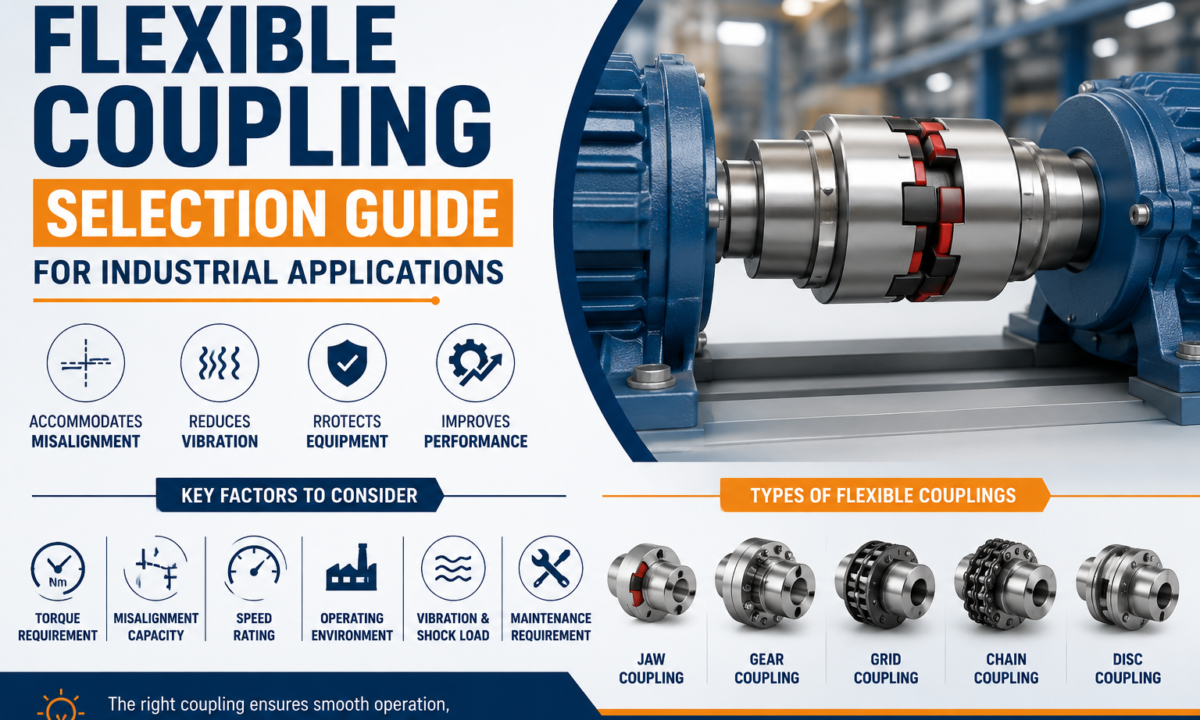
Flexible Coupling Selection Guide: How to Choose the Right Coupling for Industrial Applications.
Choosing the right flexible coupling may seem like a small decision in an industrial setup, but it can have a major impact on machine performance, maintenance costs, and equipment life.
A poorly selected coupling can lead to vibration, shaft misalignment issues, bearing damage, and frequent machine breakdowns. On the other hand, the right flexible coupling helps ensure smooth torque transmission, protects connected equipment, and improves overall operational efficiency.
In this guide, we’ll break down the key factors to consider while selecting a flexible coupling for industrial applications.
What is a Flexible Coupling?
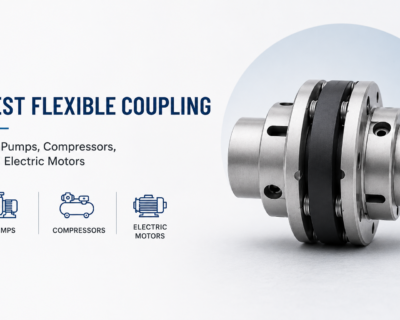
A flexible coupling is a mechanical component used to connect two rotating shafts while allowing slight misalignment, vibration absorption, and shock load protection.
Unlike rigid couplings, flexible couplings can handle:
- Angular misalignment
- Parallel misalignment
- Axial movement
- Vibration and shock loads
This makes them widely used in:
- Pumps
- Compressors
- Conveyor systems
- Gearboxes
- Motors
- Industrial automation systems
Why Flexible Couplings Are Important?
Industrial machines rarely operate under perfectly aligned conditions all the time.
Heat, load changes, vibration, and installation variations can create small shaft movements during operation. Flexible couplings help compensate for these movements while protecting critical machine components.
Some major benefits include:
- Reduced vibration
- Lower bearing stress
- Better torque transmission
- Reduced maintenance
- Improved machine lifespan
- Smoother operation
Key Factors to Consider When Selecting a Flexible Coupling
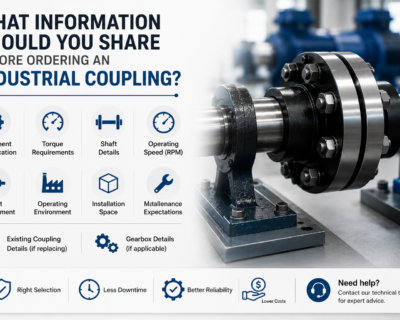
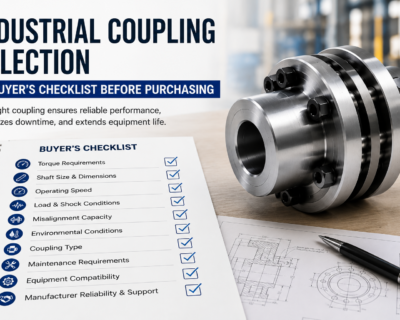
1. Torque Requirements
Torque is one of the first things you should evaluate before selecting a coupling.
The coupling must be capable of handling:
- normal operating torque,
- peak loads,
- and sudden shock loads.
If the coupling is undersized, it may fail prematurely under heavy load conditions.
Always consider a safety margin based on the application type and operating environment.
2. Type of Misalignment
No industrial machine stays perfectly aligned forever.
Flexible couplings are specifically designed to handle different types of misalignment:
- Angular misalignment
- Parallel misalignment
- Axial movement
Before selecting a coupling, understand the level and type of shaft movement expected in the system.
Different coupling designs handle misalignment differently. For example:
- Jaw couplings are good for vibration damping
- Gear couplings handle high torque
- Grid couplings perform well under shock loads
3. Operating Speed
Couplings behave differently at high RPMs.
For high-speed applications, balance and vibration control become extremely important. A coupling designed for low-speed heavy-duty systems may not perform efficiently at higher rotational speeds.
Always verify the coupling’s speed rating before installation.
4. Application Environment
The surrounding environment plays a major role in coupling selection.
Factors such as:
- dust,
- moisture,
- chemicals,
- high temperatures,
- and outdoor exposure
can affect coupling performance and lifespan.
For harsh industrial environments, choose couplings with durable materials and corrosion-resistant properties.
5. Vibration and Shock Load Handling
Some industrial machines generate continuous vibration or sudden load changes during operation.
Flexible couplings help absorb these forces and reduce stress on shafts, bearings, and motors.
Applications involving:
- crushers,
- conveyors,
- heavy-duty mixers,
- and mining equipment
Often require couplings with strong shock absorption capability.
6. Maintenance Requirements
Not all couplings require the same level of maintenance.
Some couplings need regular lubrication and inspection, while others are designed for low-maintenance operation.
If minimizing downtime is a priority, maintenance-friendly couplings can offer long-term advantages.
Common Types of Flexible Couplings
Jaw Couplings
Best for:
- General industrial applications
- Moderate torque
- Vibration damping
Gear Couplings
Best for:
- High torque applications
- Heavy-duty machinery
- Large industrial systems
Grid Couplings
Best for:
- Shock load absorption
- High vibration environments
Chain Couplings
Best for:
- Heavy torque transmission
- Rugged operating conditions
Disc Couplings
Best for:
- High-speed precision applications
- Low maintenance requirements
Common Mistakes to Avoid
Many coupling failures happen because of incorrect selection rather than poor product quality.
Avoid these common mistakes:
- Ignoring misalignment levels
- Selecting based only on price
- Overlooking the operating environment
- Using undersized couplings
- Ignoring maintenance needs
- Not considering shock loads
Choosing the cheapest option often leads to higher maintenance costs later.
Final Thoughts
Flexible couplings may look like small components, but they play a critical role in industrial machinery performance.
The right coupling helps improve efficiency, reduce vibration, protect equipment, and minimize downtime. However, selecting the wrong type can create ongoing operational problems and maintenance issues.
By understanding torque requirements, alignment conditions, operating environment, and application demands, industries can choose flexible couplings that deliver reliable long-term performance.
In industrial systems, smart coupling selection is not just about connecting shafts — it’s about protecting the entire machine.