
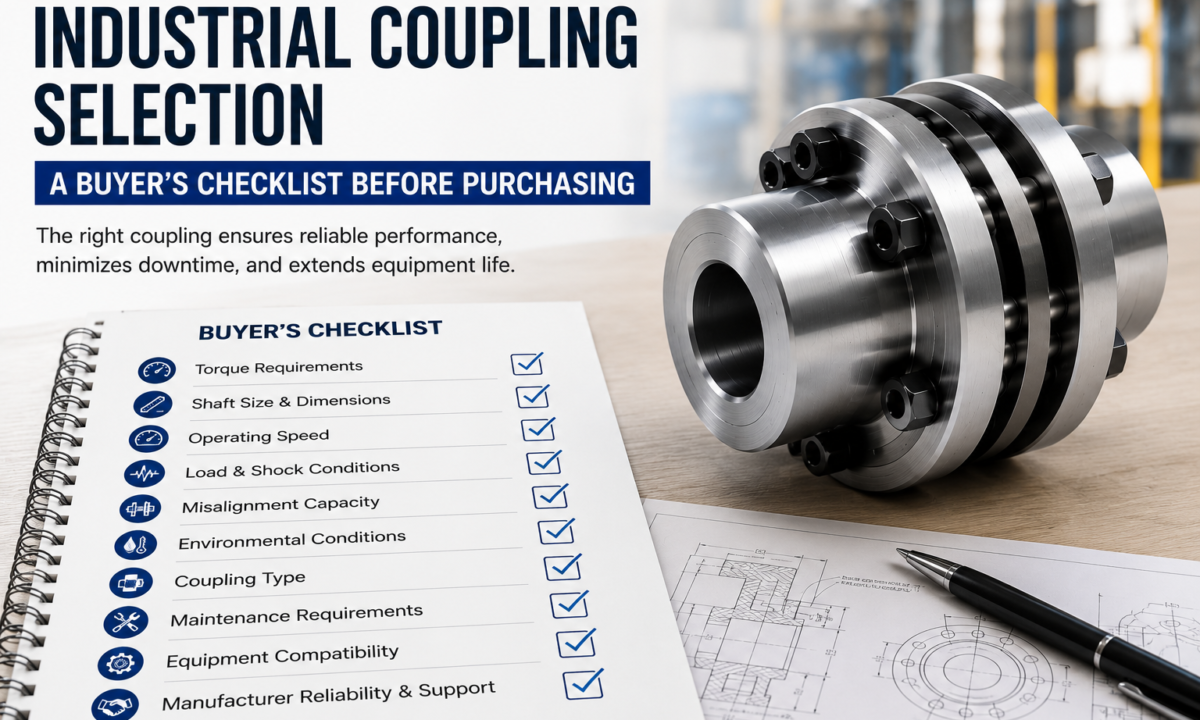
Industrial Coupling Selection: A Buyer’s Checklist Before Purchasing.
Industrial machinery depends on efficient power transmission to maintain productivity, reduce downtime, and ensure long-term operational reliability. One of the most critical components in any power transmission system is the coupling. Whether connecting motors, gearboxes, pumps, conveyors, compressors, or other rotating equipment, the right coupling plays a vital role in ensuring smooth and efficient operation.
However, selecting an industrial coupling is not always straightforward. Choosing the wrong coupling can result in excessive vibration, shaft misalignment issues, premature equipment wear, increased maintenance costs, and unexpected production downtime.
For maintenance engineers, plant managers, procurement teams, and OEMs, understanding the key factors involved in coupling selection is essential before making a purchase decision.
This buyer’s checklist will help simplify the selection process and ensure you choose the most suitable industrial coupling for your application.
Why Coupling Selection Matters?
An industrial coupling does more than simply connect two shafts. It helps transmit torque, accommodate misalignment, absorb shock loads, reduce vibration, and protect connected equipment.
A properly selected shaft coupling can help:
- Improve equipment reliability
- Reduce maintenance requirements
- Increase gearbox and motor lifespan
- Minimize downtime
- Enhance operational efficiency
On the other hand, an improperly selected coupling can lead to recurring failures and expensive repairs.
1. Understand Your Torque Requirements
The first step in coupling selection is determining the torque requirements of your application.
Before purchasing, consider:
- Running torque
- Starting torque
- Peak torque
- Shock loads
Applications such as crushers, conveyors, mixers, and heavy-duty machinery often experience sudden load variations that require higher torque capacities.
Quick Tip
Always select a coupling capable of handling peak operating conditions rather than just normal operating loads.
2. Identify Shaft Size and Dimensions
A coupling must match the shaft dimensions of the equipment it connects.
Before ordering, verify:
| Parameter | Importance |
| Shaft Diameter | Proper Fit |
| Keyway Dimensions | Torque Transmission |
| Shaft Length | Installation Compatibility |
| Bore Requirements | Correct Mounting |
Incorrect shaft dimensions can lead to installation difficulties and premature coupling failure.
3. Evaluate Shaft Misalignment
Perfect alignment is rarely achieved in industrial environments.
Common misalignment types include:
Angular Misalignment
Occurs when shafts are positioned at an angle.
Parallel Misalignment
Occurs when shafts remain parallel but offset.
Axial Movement
Occurs when shafts move along their axis.
Applications experiencing alignment variations often benefit from a flexible coupling or flexible shaft coupling that can accommodate these movements without placing excessive stress on equipment.
4. Consider Operating Speed
Rotational speed is another critical factor.
Different couplings are designed for different speed ranges.
Key Considerations
- Maximum RPM
- Continuous operating speed
- Startup conditions
- Variable speed operation
Selecting a coupling outside its recommended speed range can result in excessive wear and vibration.
5. Assess Shock Load Conditions
Many industrial applications experience shock loading during operation.
Examples include:
- Crushers
- Conveyors
- Sugar mill equipment
- Mining machinery
- Material handling systems
Shock loads can significantly affect coupling performance.
Applications exposed to heavy shock loading typically require robust solutions such as Gear Couplings or Full Gear Couplings.
6. Review Environmental Conditions
Industrial environments can be extremely demanding.
Consider factors such as:
- Dust
- Moisture
- High temperatures
- Chemicals
- Corrosive atmospheres
The operating environment often influences coupling material selection, sealing requirements, and maintenance schedules.
7. Select the Appropriate Coupling Type
Different applications require different coupling designs.
Common Industrial Coupling Types
| Coupling Type | Typical Application |
| Full Gear Coupling | Heavy-Duty Drives |
| Flexible Coupling | Pumps & Fans |
| Pin Bush Coupling | Conveyors |
| Jaw Coupling | General Industrial Equipment |
| Half Gear Coupling | Medium to Heavy Loads |
For example, a jaw coupling may be ideal for general-purpose applications, while a flexible coupling is often preferred where vibration damping and misalignment compensation are important.
8. Evaluate Maintenance Requirements
Maintenance requirements vary significantly between coupling types.
Before purchasing, consider:
- Lubrication needs
- Inspection frequency
- Spare part availability
- Ease of replacement
A coupling with lower maintenance requirements can help reduce long-term operating costs.
9. Verify Compatibility with Existing Equipment
The selected coupling should be compatible with:
- Motors
- Gearboxes
- Pumps
- Compressors
- Conveyor drives
Compatibility issues can lead to installation delays and increased project costs.
Always verify manufacturer specifications before placing an order.
10. Choose a Reliable Coupling Manufacturer
The quality of the manufacturer is just as important as the coupling itself.
Reliable coupling manufacturers typically offer:
✔ Product quality assurance
✔ Technical support
✔ Application guidance
✔ Spare parts availability
✔ After-sales assistance
Choosing an experienced supplier can significantly improve equipment reliability and long-term performance.
Common Mistakes Buyers Should Avoid
Many coupling failures occur because buyers overlook critical selection criteria.
Avoid these common mistakes:
❌ Selecting solely based on price
❌ Ignoring peak torque requirements
❌ Overlooking shaft misalignment
❌ Choosing the wrong coupling type
❌ Ignoring environmental conditions
❌ Failing to verify shaft dimensions
A careful evaluation before purchasing can prevent costly operational issues later.
Industrial Coupling Buyer’s Checklist
Before placing an order, confirm the following:
✅ Torque Requirements
✅ Shaft Size and Bore Dimensions
✅ Operating Speed
✅ Load Characteristics
✅ Misalignment Conditions
✅ Environmental Factors
✅ Maintenance Requirements
✅ Equipment Compatibility
✅ Coupling Type
✅ Supplier Support
Using this checklist can help ensure the selected coupling meets both operational and performance requirements.
Final Thoughts
Selecting the right industrial coupling is critical for ensuring reliable power transmission, minimizing downtime, and maximizing equipment life. By carefully evaluating factors such as torque, shaft size, operating speed, misalignment, environmental conditions, and maintenance requirements, buyers can make informed purchasing decisions that support long-term operational success.
Whether you need a shaft coupling, flexible coupling, flexible shaft coupling, jaw coupling, or heavy-duty gear coupling, choosing the right solution can significantly improve equipment performance and reliability.
To explore industrial coupling solutions for your application or discuss your specific requirements, connect with the team at Hylo Transmission and discover the right coupling solution for your business.
FAQs
What should I consider before purchasing an industrial coupling?
Key factors include torque requirements, shaft dimensions, operating speed, misalignment conditions, environmental factors, and maintenance needs.
What is the purpose of a flexible coupling?
A flexible coupling helps accommodate shaft misalignment, absorb vibration, and protect connected equipment from excessive stress.
Which coupling is best for heavy-duty industrial applications?
Full Gear Couplings are commonly preferred for high-torque and heavy-duty applications due to their strength and durability.
Why is coupling selection important?
Proper coupling selection helps improve equipment reliability, reduce maintenance costs, minimize downtime, and extend machinery life.