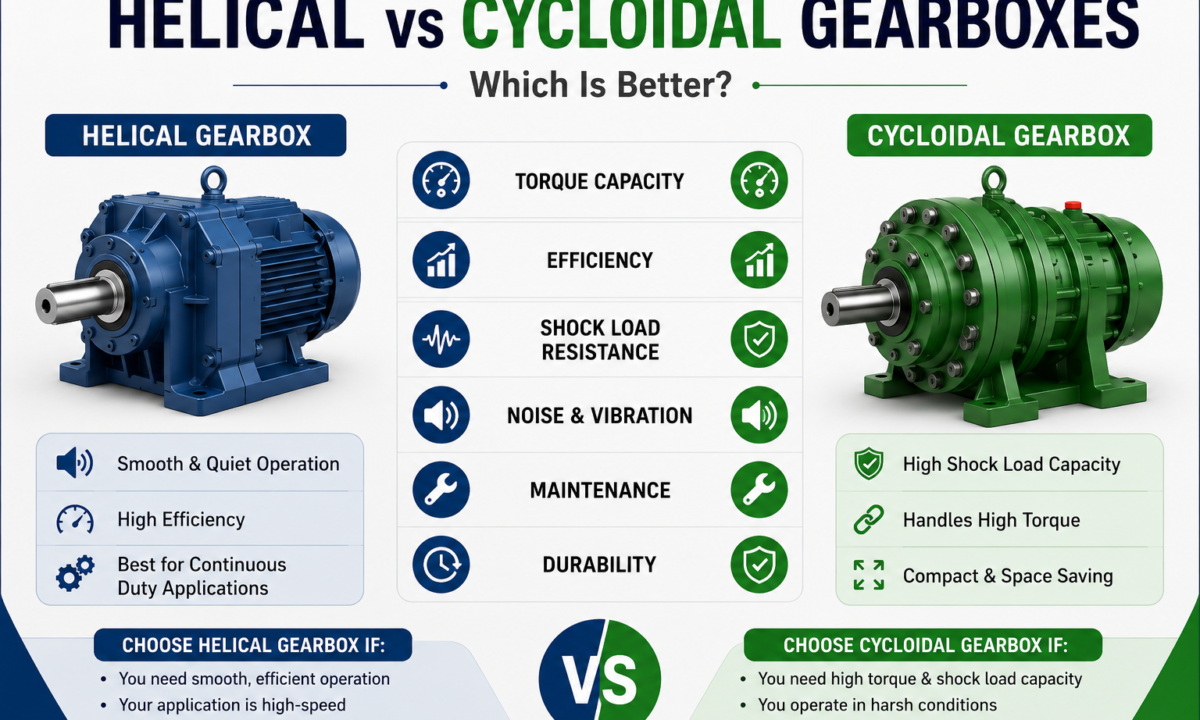
Helical vs Cycloidal Gearboxes: Which Is Better?
Industrial gearboxes play a crucial role in modern machinery by controlling speed, torque, and power transmission. Among the many gearbox types available today, helical gearboxes and cycloidal gearboxes are two commonly used options in heavy industries and manufacturing plants.
Both offer unique advantages depending on the application, operating conditions, and industrial requirements. However, many industries often struggle to decide which gearbox is better for their operations.
In this blog, we compare helical and cycloidal gearboxes based on performance, efficiency, durability, maintenance, and industrial applications to help you understand which one suits your needs better.
What Is a Helical Gearbox?
A helical gearbox uses helical gears with angled teeth that engage gradually during operation. This design allows smoother and quieter power transmission compared to traditional spur gears.
Helical gearboxes are widely used in industries where continuous operation, moderate shock loads, and high-speed applications are common.
Common Applications of Helical Gearboxes
- Conveyor systems
- Packaging machinery
- Material handling equipment
- Textile machinery
- Manufacturing plants
- Food processing industries
What Is a Cycloidal Gearbox?
A cycloidal gearbox works using a cycloidal disc mechanism instead of conventional gears. It is specially designed to handle high shock loads, heavy torque, and demanding industrial conditions.
Cycloidal gearboxes are known for their compact size, durability, and excellent resistance to impact loads.
Common Applications of Cycloidal Gearboxes
- Mining industries
- Cement plants
- Heavy-duty conveyors
- Robotics and automation
- Steel industries
- Agitators and mixers
Helical vs Cycloidal Gearboxes
1. Torque Handling Capacity
One of the biggest differences between the two is torque handling capability.
Cycloidal gearboxes are generally better for high torque and heavy shock load applications. Their design distributes load across multiple contact points, reducing stress on individual components.
Helical gearboxes also provide good torque transmission, but they are more suitable for moderate to heavy industrial loads rather than extreme shock conditions.
Winner:
Cycloidal Gearbox
2. Efficiency
Helical gearboxes are highly efficient because of their smooth tooth engagement and lower friction during operation. They are often preferred in applications requiring continuous speed and efficiency.
Cycloidal gearboxes are also efficient but may experience slightly higher friction losses depending on the design and operating conditions.
Winner:
Helical Gearbox
3. Shock Load Resistance
Industries like mining, steel, and cement often face sudden impact loads and harsh operating conditions.
Cycloidal gearboxes perform exceptionally well in such environments because they are designed to absorb heavy shock loads without damaging internal components.
Helical gearboxes may wear faster under excessive shock conditions if not properly selected.
Winner:
Cycloidal Gearbox
4. Noise and Vibration
Helical gearboxes are known for smooth and quieter operation because of the angled tooth design.
Cycloidal gearboxes can generate slightly more vibration in certain applications, especially under very high loads.
Winner:
Helical Gearbox
5. Durability and Lifespan
Cycloidal gearboxes are extremely durable and often last longer in demanding industrial applications because the load is distributed over multiple components.
This reduces wear and improves reliability in harsh operating conditions.
Helical gearboxes also offer good durability, but their lifespan may reduce faster in heavy shock load environments.
Winner:
Cycloidal Gearbox
6. Maintenance Requirements
Helical gearboxes usually require regular lubrication and maintenance for long-term performance.
Cycloidal gearboxes generally experience lower wear and may require less maintenance in heavy-duty applications.
However, proper inspection and lubrication remain important for both gearbox types.
Winner:
Cycloidal Gearbox
Which Gearbox Is Better?
The answer depends completely on your industrial application.
Choose a Helical Gearbox If:
- You need smoother and quieter operation
- Your application involves continuous high-speed performance
- Shock loads are moderate
- Energy efficiency is a priority
Choose a Cycloidal Gearbox If:
- Your application involves high torque
- Heavy shock loads are common
- You need compact yet durable transmission systems
- Reliability in harsh industrial conditions is important
Industries Commonly Using Cycloidal and Helical Gearboxes
Helical Gearboxes
- Packaging Industry
- Food Processing
- Textile Manufacturing
- Conveyor Systems
- General Manufacturing
Cycloidal Gearboxes
- Mining Industry
- Cement Plants
- Steel Industry
- Robotics
- Heavy Material Handling
Final Thoughts
Both helical and cycloidal gearboxes offer excellent industrial performance, but the right choice depends on your operational requirements.
Helical gearboxes are ideal for smooth, efficient, and quieter operations, while cycloidal gearboxes are better suited for high torque, heavy shock loads, and demanding industrial environments.
Understanding your application, load conditions, maintenance expectations, and operating environment is essential before selecting the right gearbox for your industry.
FAQs
Which gearbox is better for heavy shock loads?
Cycloidal gearboxes are generally better for heavy shock load applications because of their robust design and load distribution capability.
Are helical gearboxes more efficient?
Yes, helical gearboxes are known for smooth operation and high efficiency in continuous industrial applications.
Which industries commonly use cycloidal gearboxes?
Industries such as mining, cement, steel, robotics, and heavy material handling commonly use cycloidal gearboxes.