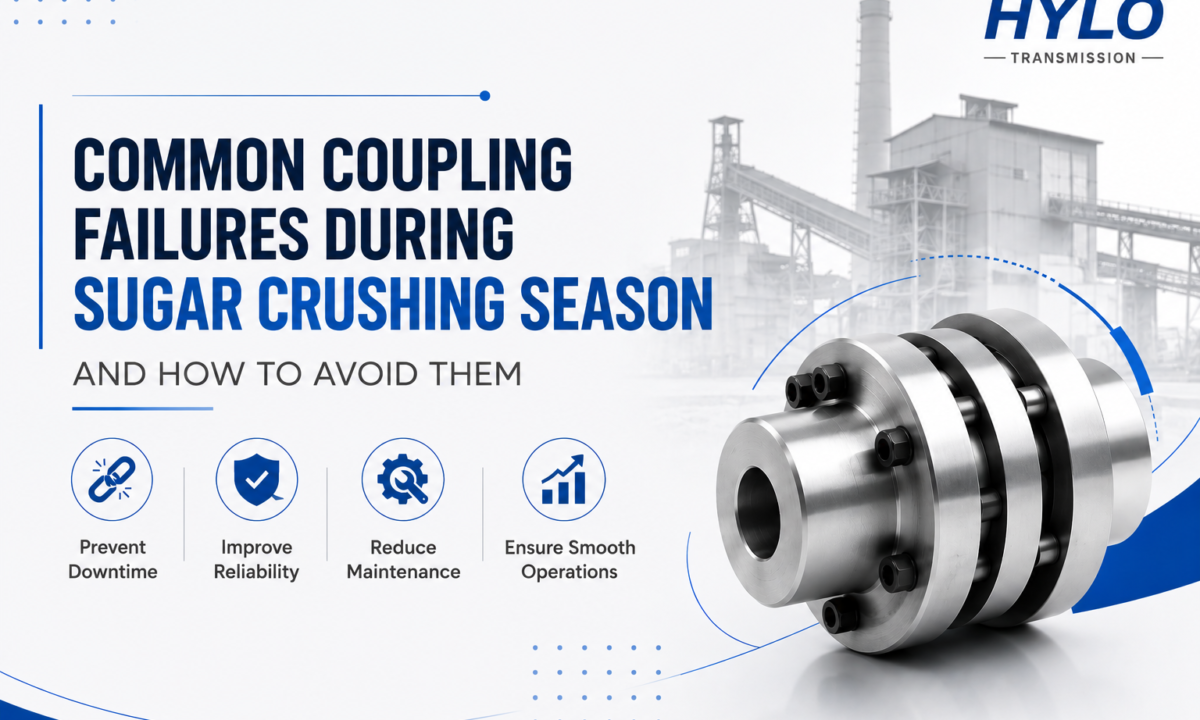
Common Coupling Failures During Sugar Crushing Season and How to Avoid Them ?
The sugar crushing season is one of the most demanding periods for sugar mills. During this time, machinery operates continuously under heavy loads to process large volumes of sugarcane within a limited timeframe. Any unexpected equipment failure can result in significant production losses, delayed operations, and increased maintenance expenses.
Among the many components involved in sugar mill operations, industrial couplings play a critical role in ensuring reliable power transmission between motors, gearboxes, conveyors, cane crushers, and other rotating equipment. Whether it is a shaft coupling, flexible coupling, or heavy-duty gear coupling, selecting the right solution is essential for maintaining continuous production during the crushing season.
However, due to harsh operating conditions, couplings are often subjected to high torque, shock loads, vibration, and misalignment, making them vulnerable to failure if not properly selected or maintained.
Understanding the common causes of coupling failure can help sugar mills reduce downtime, improve equipment reliability, and maintain smooth operations throughout the crushing season.
Why Coupling Reliability Matters in Sugar Mills ?
Sugar mills depend heavily on continuous operation. A failed industrial coupling can bring an entire production line to a halt, affecting critical equipment such as:
- Cane Crushers
- Mill Drives
- Conveyor Systems
- Pumps
- Centrifuges
- Bagasse Handling Equipment
Reliable couplings help ensure smooth power transmission while protecting connected machinery from excessive stress, vibration, and misalignment. Choosing the correct shaft coupling for each application can significantly improve operational efficiency and equipment lifespan.
1. Shaft Misalignment
One of the most common causes of shaft coupling failure in sugar mills is shaft misalignment.
Misalignment can occur due to:
- Improper installation
- Foundation movement
- Equipment vibration
- Thermal expansion
When shafts are not properly aligned, excessive forces are transferred to the coupling, bearings, and gearbox. Even a high-quality flexible coupling can experience accelerated wear if alignment issues are ignored for extended periods.
Warning Signs
✔ Excessive vibration
✔ Bearing failures
✔ Increased operating temperature
✔ Premature coupling wear
How to Avoid It
- Conduct regular alignment inspections.
- Use laser alignment tools whenever possible.
- Select couplings capable of handling minor misalignment.
Proper alignment significantly improves the lifespan of both the coupling and connected equipment.
2. Excessive Torque Loads
During peak crushing operations, sugar mill machinery often experiences sudden load variations.
Applications such as cane crushers and heavy-duty conveyors generate substantial torque loads that can exceed coupling design limits.
This is particularly common when undersized couplings are used.
Warning Signs
✔ Cracked coupling components
✔ Tooth wear in gear couplings
✔ Frequent coupling replacement
How to Avoid It
- Accurately calculate operating torque.
- Consider peak and shock load conditions.
- Use Full Gear Couplings for high-torque applications.
Heavy-duty applications require couplings specifically designed to handle demanding operating conditions.
3. Poor Lubrication in Gear Couplings
For Gear Couplings, proper lubrication is essential for smooth operation and reduced wear.
Insufficient lubrication can result in:
- Increased friction
- Excessive heat generation
- Accelerated gear tooth wear
- Reduced service life
Warning Signs
✔ Overheating
✔ Metal particles in lubricant
✔ Excessive gear wear
How to Avoid It
- Follow recommended lubrication schedules.
- Use manufacturer-approved lubricants.
- Inspect lubrication levels regularly during crushing season.
Routine lubrication is one of the simplest and most cost-effective maintenance practices.
4. Shock Load Damage
Sugar processing equipment frequently experiences sudden load fluctuations.
Examples include:
- Cane feeding variations
- Conveyor jams
- Mill startup conditions
These shock loads can place excessive stress on couplings and connected machinery.
Warning Signs
✔ Coupling cracks
✔ Broken pins or bushes
✔ Excessive vibration
How to Avoid It
- Select couplings designed for shock load applications.
- Use Pin Bush Couplings where vibration absorption is required.
- Inspect couplings periodically during operation.
Proper coupling selection can significantly reduce the impact of shock loading.
5. Dust and Contamination
Sugar mills generate large amounts of dust, moisture, and debris.
These contaminants can enter coupling assemblies and accelerate wear.
Contamination often leads to:
- Lubricant degradation
- Increased friction
- Corrosion
- Premature component failure
Warning Signs
✔ Visible contamination
✔ Rust formation
✔ Increased maintenance frequency
How to Avoid It
- Use properly sealed coupling designs.
- Perform regular cleaning and inspection.
- Replace damaged seals immediately.
Environmental protection is critical for long-term coupling reliability.
6. Incorrect Coupling Selection
Many coupling failures occur simply because the wrong coupling type was selected for the application.
Recommended Coupling Selection
| Application | Recommended Coupling |
| Cane Crushers | Full Gear Coupling |
| Heavy Conveyors | Full Gear Coupling |
| Material Handling | Pin Bush Coupling |
| Pumps | Flexible Coupling |
| Centrifuges | Flexible Coupling |
Different applications require different coupling designs. While a flexible shaft coupling may be suitable for equipment requiring vibration damping and misalignment compensation, high-torque sugar mill drives often rely on heavy-duty gear couplings. In certain auxiliary applications, a jaw coupling may also be used where moderate torque transmission and ease of maintenance are priorities.
Selecting a coupling based solely on cost often results in higher maintenance expenses and increased downtime.
Impact of Coupling Failures on Sugar Mill Operations
Coupling failures can have significant consequences during the crushing season.
| Issue | Operational Impact |
| Production Downtime | Reduced Output |
| Gearbox Damage | Expensive Repairs |
| Bearing Failures | Increased Maintenance |
| Conveyor Shutdowns | Material Flow Disruptions |
| Unexpected Breakdowns | Lost Revenue |
By addressing coupling issues proactively, sugar mills can minimize these risks and maintain consistent production levels.
Best Practices to Prevent Coupling Failures
To maximize reliability during crushing season:
✅ Conduct regular alignment checks
✅ Monitor vibration levels
✅ Follow lubrication schedules
✅ Inspect couplings for wear and damage
✅ Replace worn components before failure occurs
✅ Select couplings based on actual operating conditions
✅ Work with trusted coupling manufacturers
Preventive maintenance is far less expensive than unplanned downtime.
Final Thoughts
The sugar crushing season places tremendous demands on machinery and power transmission systems. Common issues such as shaft misalignment, shock loading, poor lubrication, contamination, and incorrect coupling selection can lead to costly failures if left unaddressed.
Investing in high-quality industrial couplings, whether a shaft coupling, flexible coupling, flexible shaft coupling, or heavy-duty gear coupling, can help sugar mills improve reliability, reduce maintenance costs, and minimize production interruptions throughout the crushing season.
If you’re looking for dependable Full Gear Couplings, Pin Bush Couplings, and other power transmission solutions for sugar mill applications, explore the industrial coupling range offered byHylo Transmission.
Investing in the right coupling solution can help sugar mills improve reliability, reduce maintenance costs, and minimize downtime during the crushing season. To discuss your application requirements and find the right coupling solution, visit our industrial coupling experts
FAQs
What is the most common cause of coupling failure in sugar mills?
Shaft misalignment is one of the leading causes of coupling failure, often resulting in excessive vibration, bearing damage, and premature wear.
Which coupling is best for sugar mill cane crushers?
Full Gear Couplings are commonly used for cane crusher applications because they can handle high torque loads and demanding operating conditions.
How often should couplings be inspected during crushing season?
Critical couplings should be inspected regularly and included in preventive maintenance schedules throughout the crushing season.
Can coupling failures damage gearboxes?
Yes. A damaged or improperly selected coupling can transfer excessive stress to gearboxes, bearings, and shafts, leading to costly repairs and unexpected downtime.